Monday, July 31, 2006

N WIND 10 KT...RISING TO 15 KT IN THE AFTERNOON.
WIND WAVES 2 FT.
NW SWELL 3 FT AT 8 SECONDS.
TONIGHT NW WIND 10 TO 15 KT.
WIND WAVES 2 FT.
NW SWELL 4 FT AT 11 SECONDS.
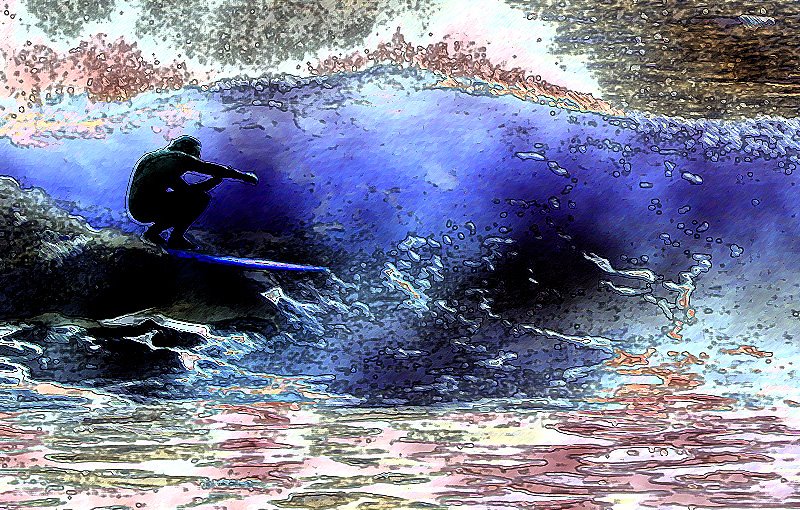
A report from stiffler:
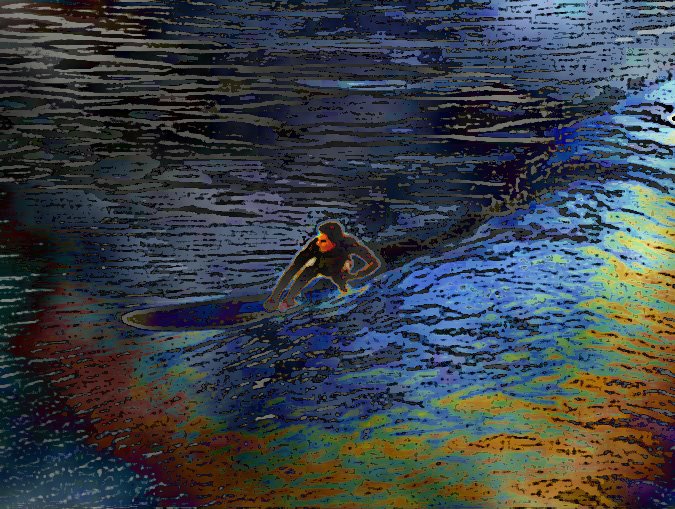
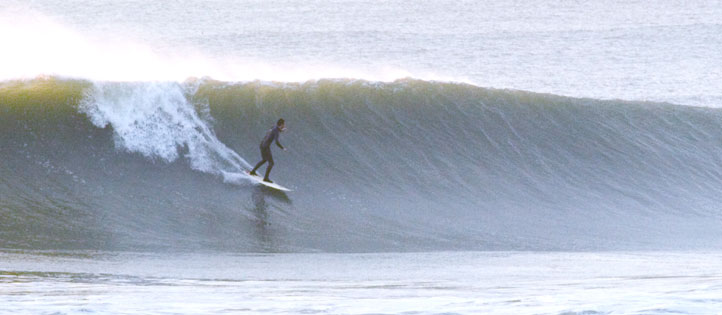
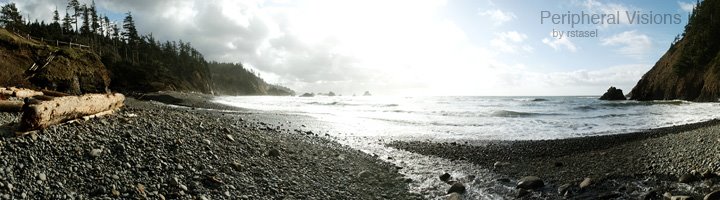
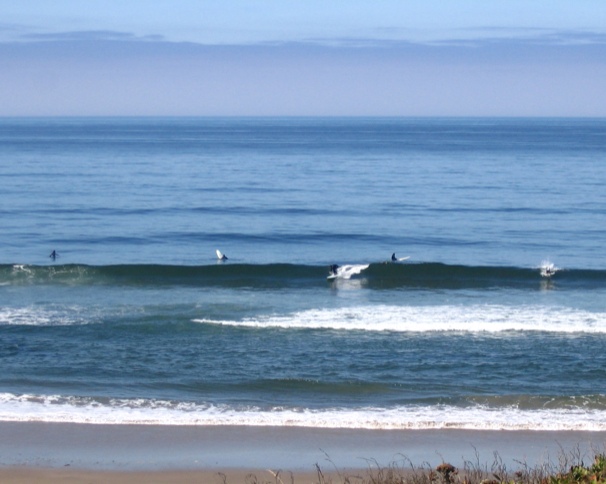
When I skipped out on lunch to go surf, I didnt expect much.
Otter was about the best of the worst, so down to the sea I went.
There were five hundred people down there, a veritable flotilla of soft tops.
People dragging the boards on the sand, waxing the bottom, spongers, bathers, kids, polar bear clubbers, everybody.
I paddled out on the board I made, and who do I paddle out right next to but the guy who took me out surfing for the first time ever five years ago.
We seldom cross paths, and were glad to see each other.
He was clearly impressed with my board, and I was happy to swap with him and see what he could make it do.
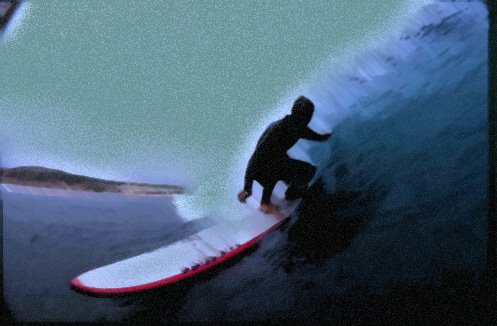
He got in a little barrell right off the bat, and got a couple other solid rides. Meanwhile, I got to ride the very same board I stood up on the first time ever at the very same spot.
He seemed to like the board a lot, and it really felt good.
Talk about things going full circle.
We didnt talk much, just caught a few rides, agreed to meet up again, and had to head back in to go to work.
I dont know about the waves, but it was a good day.
Sunday, July 30, 2006

W TO SW WIND 10 TO 15 KT...VEERING TO NW IN THE AFTERNOON.
WIND WAVES 2 FT.
W SWELL 3 FT AT 9 SECONDS.
TONIGHT N WIND 10 TO 15 KT.
WIND WAVES 2 FT.
W SWELL 3 FT AT 9 SECONDS.
Historically, the Oregon coast was a dangerous place for early maritime trade. Strong winds buffeted the shores and headlands, narrow channels and fluctuating bars were the rule at entrances of bays and rivermouths, and headlands and growing towns were remote and isolated. Mariners desperately needed services. The bar of the Columbia gained a reputation and description as the "graveyard of the Pacific." Boats foundered, grounded, and smashed on rocky headlands, taking hundreds of lives. While efforts to chart this rugged coastal wilderness and compile information on its hazards, the U.S. Light-house Board was called upon to provide more assistance.
Congress appropriated funds for design and construction of important facilities on a case by case basis. These included lighthouses: Cape Arago (1866), Cape Blanco (1870), Yaquina Bay (1872), Cape Foulweather (1873), Point Adams (1875), Tillamook Rock (1881), Warrior Rock (1888) at the mouth of the Willamette River, Cape Meares (1890), Umpqua River, Heceta Head, Coquille River (all 1894), and Desdemona Sands (1905). The goal was to create a system of stations with interlocking lights. On a clear night at sea, a mariner might expect to sight at any point a distinctive beacon on shore to pinpoint the location. Fog signals powered by steam engines blasted warnings from a number of the stations to tell captains to drop anchor or beat a retreat until the mists cleared.
In 1892 an appropriation of $60,000 funded construction of Columbia River Lightship No. 50. Anchored off the treacherous bar of the Columbia, the lightship had a lonely crew of eight who, for decades, kept watch, maintained kerosene lights, and fed coal into boilers to power a massive fog signal. Their wave-tossed perch with booming horn drew hardy men who, like those at remote lighthouses, endured modest pay and isolation.
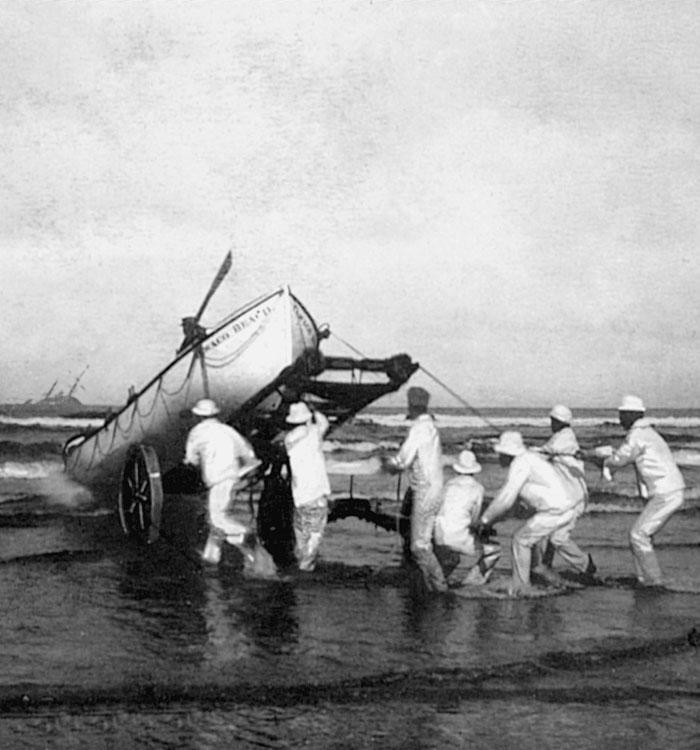
Congress also funded construction of stations and staffing for the U.S. Life-Saving Service. The first station opened in 1878 at the Cape Arago Lighthouse near the entrance to Coos Bay. Numerous shipwrecks and loss of life associated with the export of coal and lumber from the harbor brought federal action. The small building had a surfboat and one oarsman. Launching the craft and rowing to a vessel in distress depended upon volunteers. By the end of the 19th century the U.S. Life-Saving Service had stations at Warrenton, Tillamook Bay, Yaquina Bay, Coos Bay, and the Umpqua and Coquille Rivers. Each had crew quarters, a boat house, and a practice mast for breeches-buoy drill. In the early 20th century the USLSS erected stations at Port Orford and Siuslaw River.
~from the Oregon Blue Book website
Saturday, July 29, 2006
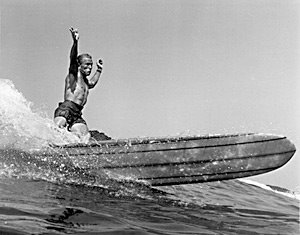
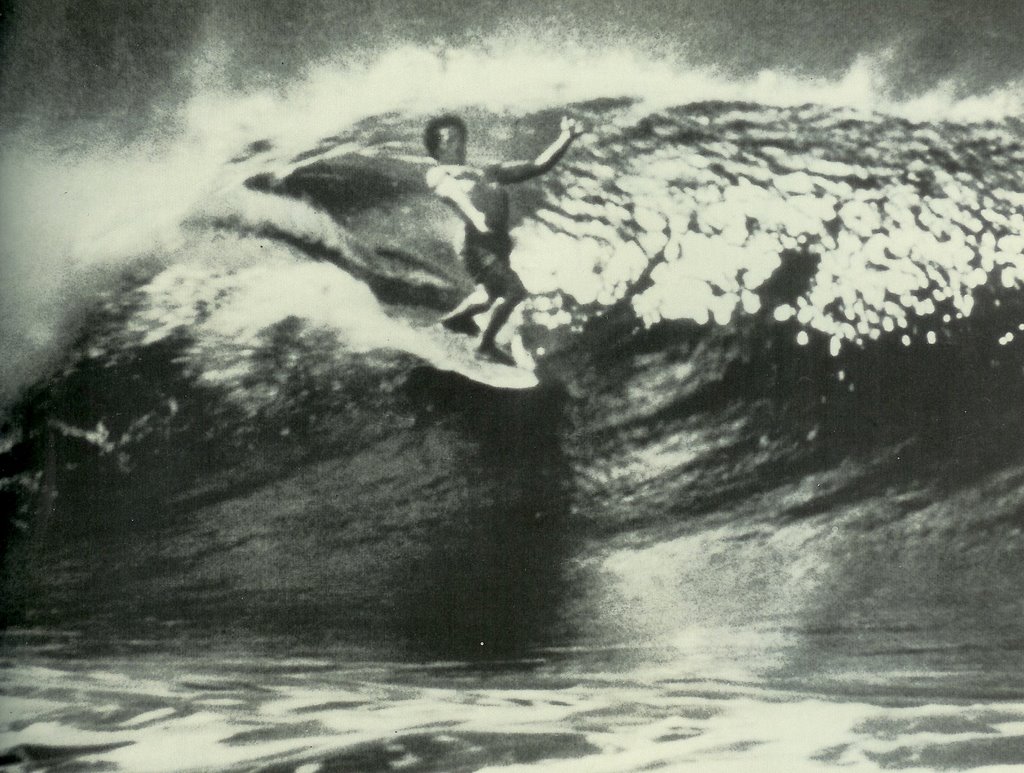
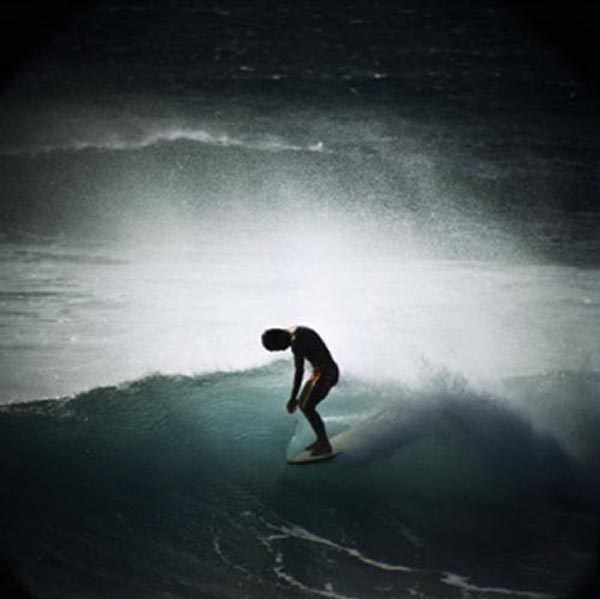
~Dewey Weber's trademark cutback...courtesy of Leroy Grannis
NW WIND 10 TO 15 KT.
WIND WAVES 2 FT.
W SWELL 6 FT AT 9 SECONDS.
TONIGHT W WIND 10 TO 15 KT...BACKING TO SW AFTER MIDNIGHT.
WIND WAVES 2 FT.
W SWELL 5 FT AT 10 SECONDS.
Little Man on Wheels…
Always on the move…
Others stood and posed…
Dew Dew slashed and rode…
Manhattan Beach in ‘46…
Watching Dale and Simmons…
An early era hotdogger…
11 foot hot curl…
Tough for a boy of 9…
2 years for that first wave…
2 years for his first beer at 11…
Master of the yo-yo…
High School wrestling champ…
Velzy team rider…
Sombreroed Cali lifeguard…
Makaha with Buff and Buzzy…
North Shore class of ’57…
Took over where Velzy left off…
Bad blood, they never spoke again…
Late 60’s shortboard revolt…
Dewey went fishing…
Friday, July 28, 2006

NW WIND 10 TO 15 KT.
WIND WAVES 2 FT.
NW SWELL 7 FT AT 8 SECONDS.
TONIGHT NW WIND 10 TO 15 KT.
WIND WAVES 2 FT.
NW SWELL 6 FT AT 9 SECONDS.
The most famous shipwreck on the Oregon coast:
Transcript of the Naval Court findings (Issued in London by the Board of Trade on the 24th December 1906.)
"(No. 7011.) "PETER IREDALE."
FINDING and order of a Naval Court held at the British Vice-Consulate, Astoria, Oregon, on the 12th and 13th days of November, 1906, to investigate the stranding of the British four-masted barque "PETER IREDALE"
The "Peter Iredale" was a sailing vessel, four-masted steel barque, of 1,993 tons registered tonnage, official number 97790, and built at Maryport, England, in 1890, and belonging to the port of Liverpool, owners P. Iredale & Porter.
In appears from the evidence given before the Court that the ship sailed from Salina Cruz, Mexico, on or about the 26th of September, 1906, with 1,000 tons of ballast, and a crew of 27 hands all told, including two stowaways. No incident worthy of mention happened until the look-out sighted the light on Tillamook Rock at 3.20 a.m. on the 25th of October, 1906. The ship’s course was altered to E.N.E. until the vessel was five miles off the light. The course was then altered to sight the Columbia River lightship. This was sighted and recognized, it bearing N.E. In this position, finding the wind was veering to westward, and having lost sight of the light in a thick mist, it was decided to wear ship to avoid the influence of the current setting to the north, and the tide running into the Columbia River. The wind had now hauled to north of west in heavy squalls with rain. Just before striking, while in the act of wearing, an exceedingly heavy west north-west squall struck the vessel, throwing her head off, she taking the ground, and shortly afterwards losing her upper spars. She then drove ashore, with a high south-west sea running, and a fresh westerly gale.
We consider that everything was done by the master to get his ship out of danger, but that the set of the current and the sudden shift of wind drove him so close in that in the act of wearing around to get his ship’s head off shore, she stranded. The Court, having regard to the circumstances above stated, finds as follows:—
That the position of the ship before the shift of wind was not one of danger. She was in the usual cruising ground of the pilot schooner, but unfortunately no pilots were on the station, the pilot boat being in port under repairs.
We consider that prompt action was taken by the master immediately the wind shifted, to get his ship’s head off shore, and by all accounts he was ably seconded by his officers and men. Having carefully considered the evidence, we do find that the master, and his first and second officers, are in no wise to blame for the stranding of the said vessel, and their certificates having accordingly been returned to them.
The Court further desires to put on record their appreciation of the prompt action of the United States life-saving crew at Hammond in having the lifeboat alongside in the heavy surf, and the help given by the captain of the boat when ashore; also of the action of the commander, Col. Walker, U.S.A., and his officers and men, of Fort Stevens for their attention to the wants of the wet and hungry men when at the Fort. And lastly, the Vice-Consul desires to express his satisfaction with the quiet and orderly behaviour of the crew when in Astoria.
Given under our hands at the British Vice-Consulate at Astoria, Oregon, on the thirteenth day of November, A.D. 1906.
P. L. CHERRY, British Vice-Consul, President of Court.
D. WILLIAMS, Master, Barque" Robert Duncan."
ROBT. MOORE, Master, Barque "Bankburn."
N. D. JOHNSON, Clerk of the Court."
(Issued in London by, the Board of Trade on the 24th day of December, 1906.)
Thursday, July 27, 2006

N WIND 20 TO 25 KT.
WIND WAVES 6 FT.
NW SWELL 7 FT AT 7 SECONDS.
TONIGHTN WIND 20 TO 25 KT...BECOMING NW 10 TO 20 KT AFTER MIDNIGHT.
WIND WAVES 6 FT...SUBSIDING TO 4 FT AFTER MIDNIGHT.
NW SWELL 7 FT AT 8 SECONDS.
Not surf...but, always good after surf.
Local Report:
...Thursday - Great day. Fucking Cold, waist to chest. Wind wasn't a factor most the morning. Sun never poked it's head out. Water was a beautiful emerald color.~Grave Wisdom
My crew and I had a peak to ourselves for about 2 hours. Peaky rights and speedy lefts. Glassy. Great longboard waves. About the time others saw we had the best deal on the beach, the waves shut down. Early bird gets the worm.
Same deal as usual, incoming tide brought more closeouts. Around noon, it was a shortboard zoo between 2nd and 3rds.
Of of my crew got himself covered for the first time today.
Wednesday, July 26, 2006

N WIND 20 TO 25 KT DECREASING TO 10 TO 20 KT NEAR SHORE AFTER MIDNIGHT.
WIND WAVES 6 FT.
NW SWELL 6 FT AT 10 SECONDS.
I'll tell you what...
It was a helluvalot windier than the forecast...
Surfed one of the few protected coves today on the north coast...
Got in the water around 2pm...
At about 3, the place lit up...albeit breifly...
There were justified hoots...
Saw one guy pull off a genuine barrel...
The set waves were solid head high...
The rights were blown down flat quickly...
But the lefts occassionally were held open...
Even though they wanted to close out they couldn't...
I tried to pull into one of my own...
And while I was close, it was no cigar...
Just a screamer that I couldn't quite get ahead of...
All in all, a pretty fun day at Oregon's crowdedest beach...
Even with 40 people in the water...
I only had to jockey one time for a wave...
And yes, I got it.
Tuesday, July 25, 2006
Monday, July 24, 2006

N WIND 15 KT...RISING TO 20 TO 25 KT IN THE AFTERNOON.
WIND WAVES 3 FT...BUILDING TO 6 FT IN THE AFTERNOON.
NW SWELL 10 FT AT 10 SECONDS.
SUBSIDING TO 8 FT AT 10 SECONDS IN THE AFTERNOON.
TONIGHT N WIND 20 TO 25 KT...EASING TO 15 TO 20 KT AFTER MIDNIGHT.
WIND WAVES 6 FT...SUBSIDING TO 3 FT AFTER MIDNIGHT.
NW SWELL 8 FT AT 9 SECONDS.
Looks like it could be solid early today...
There's nothing like being in the slot...
When the lip tosses over the top...
Instant bliss...
Sunday, July 23, 2006

N WIND 10 TO 15 KT...RISING TO 20 TO 25 KT IN THE AFTERNOON.
WIND WAVES 3 FT...BUILDING TO 6 FT IN THE AFTERNOON.
NW SWELL 7 FT AT 10 SECONDS.
TONIGHT N WIND 20 TO 25 KT...BECOMING NW 15 TO 20 KT AFTER MIDNIGHT.
WIND WAVES 6 FT...SUBSIDING TO 4 FT AFTER MIDNIGHT.
NW SWELL 7 FT AT 9 SECONDS... BUILDING TO 9 FT AT 9 SECONDS AFTER MIDNIGHT.
I have owned a couple Donald Takayama shapes throught the years and have to admit to being sorely tempted recently by an epoxy egg of his design...I have a difficult time justifying the purchase of a mass-produced surftech surfboard however...and so passed.
From the Surftech website...here's Donald's bio and his reasoning for producing surftech boards:
Remember the very first pullout poster SURFER ever did? Sure you do. It came out in like 1960 or 1961, and the surfer was Donald Takayama at Ala Moana circa 1959. "I had my arm stuck all the way into that wave so I wouldn't spin out," Takayama said. A little less than 50 years later, Takayama is alive and well and still arm deep in the surf industry, punching out surfboards around the clock from Hawaiian Pro Designs in Oceanside, and teaming up with SurfTech to meet the demands he can't do by hand.
Shapers come and go and come back again. Takayama has been hard at it since the middle-50s from Hawaii to California and back again. with very few detours. Takayama claims some fine names as shaping influences: Dale Velzy, Renny Yater Pat Curren, Mike Diffenderfer, Ken Tilton, Hap Jacobs, Joe Quigg, His first surfboard was a redwood in Hawaii, around 1948. Where did he get the redwood? "Railroard tracks," Takayama said. "They were changing railroad ties and had all these old ones on the side of the road and so I went over there and helped myself to it."
Takayama started surfing in Hawaii and worked for John Price and Surfboards Hawaii before he came to California in the middle 50s on a wing and a prayer. "Yeah you know I left Hawaii with a one-way ticket on one of those cattle planes, Trans Continental Airlines. Halfway over I go up and knock on the cockpit door and say, "Hey, Captain, we almost there yet or what, brah?' I showed up in LA when the only airport was at Burbank. I think I had $10 in my pocket. It was 1955 or 1956 or something like that. I have memory lapse now."
Takayama also can't remember how many boards he has shaped over the years, only that he has been doing it almost non stop since the middle 50s. He worked for ????? in Hawaii and ???? in 19?? He opened Donald Takayama Hawaiian Pro Designs in Encinitas but there were too many people poking their heads in asking "What's up?" He moved it all to Oceanside and has been there ever since.
He's been going non-stop for the last 35 years. He was one of the Refounding Father who promoted the resurgence of longboarding in the early 90s. " I was working with Oxbow and Joel Tudor and Nat Young promoting the World Championships in France. Everyone came and it was enlightening to see everyone so excited. And from there it just kept escalating. I make boards for California but there are Takayama licenses in Australia and Japan and France. The demand is amazing. I had no idea surfing would be as large as it is today and as a manufacturer I know there is no way I or any of us can fulfill this market."
Takayama is and always has been prolific and he now has 12 different designs for Surf Tech. "Speed shapes. Hybrids. Noseriders. SurfTech is making my boards from 7' 2" to 10'. There is a Stephen Slater model and a Jeff Hakman model and the Model T and a board he calls In the Pink, which is a 9'3" by 20" noserider.
Takayama loves the Surf Tech system for a lot of reasons, but especially because they are hard to ding. "The boards are lightweight and very durable. You get what you pay for. The boards withstand a lot of abuse and they don't fall apart. The Surf Tech boards have longevity. They're like the family car."
Saturday, July 22, 2006

NW WIND 10 TO 15 KT...RISING TO 15 TO 20 KT IN THE AFTERNOON.
WIND WAVES 2 FT...BUILDING TO 4 FT IN THE AFTERNOON.
W SWELL 7 FT AT 11 SECONDS.
TONIGHT NW WIND 15 TO 20 KT...EASING TO 10 TO 15 KT AFTER MIDNIGHT.
WIND WAVES 4 FT...SUBSIDING TO 2 FT AFTER MIDNIGHT.
W SWELL 8 FT AT 10 SECONDS.
Should be big enough to keep the bobbers and blow-its well to the inside...
Friday, July 21, 2006
Thursday, July 20, 2006

N WIND 10 TO 15 KT...RISING TO 20 TO 25 KT IN THE AFTERNOON.
WIND WAVES 3 FT... BUILDING TO 6 FT IN THE AFTERNOON.
W SWELL 2 FT AT 11 SECONDS.
TONIGHT N WIND 20 TO 25 KT...EASING TO 10 TO 15 KT NEAR SHORE AFTER MIDNIGHT.
WIND WAVES 4 FT.
W SWELL 4 FT AT 9 SECONDS.
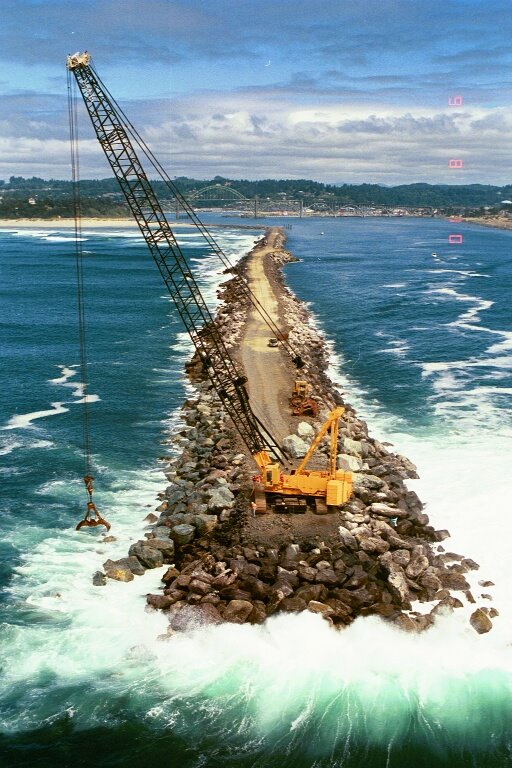
As early as 1884, jetties had been constructed at the Yaquina bar to aid ships in and out of the harbor. They were short jetties, and according to local seamen, inadequate from the beginning. But they did permit ships to enter and leave the
harbor relatively safely.
The first vessel recorded to enter Yaquina Bay was the Calamet, sent in 1856 to provision 2nd Lt. Philip H. Sheridan at the Coast Reservation. Many vessels entered the bay after exploitation of the oyster beds and settlement began in 1864. Vessels were frequently constructed on the bay in succeeding years. The Pioneer of 82 feet length was built above Elk City by Kelly Brothers in 1872; two years later, the side wheeler, Mollie, was built at Elk City.
South Jetty work started in 1887 when a 3,748 foot jetty was built. The project was finally completed in 1896. Additional work was done in 1919-1922, 1933-1934, and 1971-1972. Engineers between 1889-1896 built a North Jetty of 2,300 feet. New extensions and maintenance were done on the North Jetty regularly over the years---192l-1925, 1933-1934, 1939-1940, 1956-1957, and 1964 to 1967.
Wednesday, July 19, 2006
Tuesday, July 18, 2006

N WIND 15 KT WITH EVENING GUSTS 20 KTS.
WIND WAVES 2 FT.
NW SWELL 3 FT AT 8 SECONDS.
Blowing pretty hard today...
The north central coast was largely blown to shreds from LC on north...
Decided to walk in to a protected cove on the north coast...
It wasn't particularly memorable...
But a southwest facing beach with a brisk north wind resulted in some fun...
Little shin to thigh high peelers that made me glad I brought a 9'6" single fin...
I watched and wondered at the many who choose little potato chip shortboards...
Those that could paddle into the gutless surf couldn't milk the little waves for more than a turn or two...
Meanwhile the longboard brigade was riding the bumps from the outside to the shallows...
About the shipwreck...
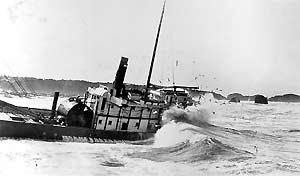
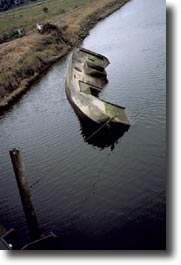
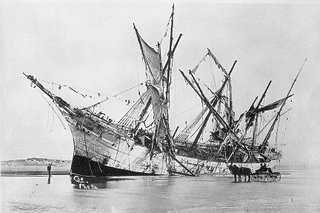
The 174-foot, 634-ton steam schooner Fifield, was hit by a southerly on Feb. 21, 1916, while trying to cross the Coquille River bar. The Fifield tried to follow another ship, the Brooklyn, over the bar but its propeller hit the rocks and a wave pushed it sideways. The vessel eventually landed on the jetty, where the 22 crewmen and four passengers got off the ship. Local residents salvaged the cargo — lumber — as it drifted ashore.
Monday, July 17, 2006

N WIND 20 TO 25 KT.
WIND WAVES 5 FT.
NW SWELL 4 FT AT 8 SECONDS.
TONIGHT N WIND 20 TO 25 KT...EASING TO 15 KT AFTER MIDNIGHT.
WIND WAVES 5 FT...SUBSIDING TO 2 FT AFTER MIDNIGHT.
NW SWELL 4 FT AT 6 SECONDS.
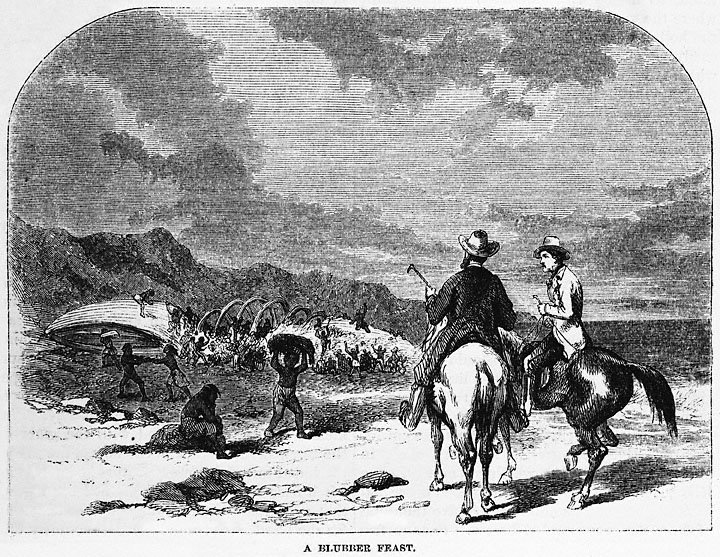
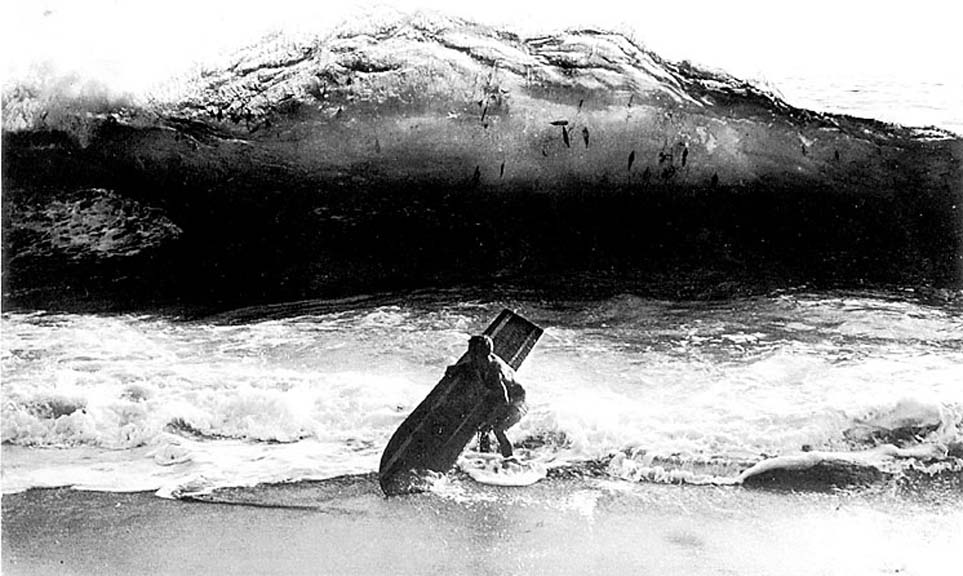
The sketch shown here was published in the June 1856 issue of Harper’s Monthly. It depicts a group of Coos Indians butchering a whale on the shore of Coos Bay in the fall of 1855. The author of the article which accompanied the illustration noted that the whale, probably a humpback, had been on the beach for some time and that “all the air was a putrid stench.” Nevertheless, dozens of Indian men and women were eagerly butchering the animal. The author’s description of a child with a distended abdomen suggests that they were seriously malnourished at the time.
The Coos were a group of related people whose territory centered around Coos Bay. Like other Native peoples of the Northwest Coast, the Coos relied heavily on salmon for their subsistence, though they also utilized a wide variety of other resources, including herring, smelt, shellfish, roots, berries, deer, elk, and, as this sketch shows, whales.
William Clark and Meriwether Lewis were the first to describe the use of whales by Native peoples in what would later become the states of Oregon and Washington. Clark noted that the “Whale is Sometimes pursued harpooned and taken by the Indians of this Coast,” but it is unclear which groups he was referring to. While the Native peoples of Vancouver Island and the Olympic Peninsula hunted whales at sea, there is little evidence to suggest that any Native groups south of those areas hunted the marine mammals.
The beaching of the whale at Coos Bay in the fall of 1855 was a fortunate event for the Coos, whose society had been seriously disrupted by waves of epidemic disease and the arrival of white gold miners. Earlier that year the Coos had agreed to sell their lands to the federal government, but the U.S. Senate never ratified their treaty. In 1860, most of the Coos were forcibly relocated to the Alsea Reservation, although many returned to their homeland when that reservation was closed in 1875. Today their descendents are organized into the Confederated Tribes of the Coos, Lower Umpqua, and Siuslaw Indians.
~from Oregon Historical Project
Sunday, July 16, 2006

N WIND 15 TO 20 KT.
RISING TO 20 TO 25 KT IN THE AFTERNOON.
WIND WAVES 4 FT.
W SWELL 5 FT AT 10 SECONDS.
TONIGHT N WIND 20 TO 25 KT...BECOMING NW 15 TO 20 KT AFTER MIDNIGHT.
WIND WAVES 5 FT.
W SWELL 4 FT AT 8 SECONDS.
One of the truly great surfers of the postwar era, Midget Farrelly has become part of a polarized debate in his Australian homeland. To many, he is one half of a classic very personal feud with the nation's other world champ of the '60s, Robert "Nat" Young. While it's true the pair have hugely different personal styles --Midget's restrained and intelligent, Nat's loud and large -- the debate has been largely unfair to Farrelly, whose contribution to his sport goes far beyond the feud.
Born in Sydney, Farrelly had his first surf experiences at North Bondi beach in the early '50s. This was the heart of old-style Australian beach culture; the realm of the volunteer lifesaver "surf clubs," where the country's few surfers would leave their big wooden boards overnight because they were too heavy to carry home on cars or bikes. It rubbed off on Midget, and later in life, he would return to the surf clubs, looking for some of the "innocence" (his description) that he'd felt had vanished from the surfing scene.
Quickly nicknamed "Midget" for his slight build among the big men of the beaches, a barely teenage Farrelly saw California's Greg Noll surfing Sydney waves during Da Bull's lifeguard-sponsored visit in 1956 and realized: you could "corner." By 1961, the Malibu-style lightweight boards were being churned out and Midget was the Australian surfing champion. In 1962, he went to Hawaii and won the Makaha International championship in 6-foot surf, using a quick, light-footed surfing style.
In 1964, the International Surfing Federation had pulled together the world's surfing nations enough to stage a first-ever World Surfing Championships. The venue was Manly Beach on Sydney's north side, which must have seemed a strange location to some. At the time, Australia was hardly the epicenter of surfing. But Australian gasoline company Ampol had put up the bucks, and the Aussies were ready to step up. Sixty thousand people lined the Manly shores to watch Midget take the men's crown ahead of surfers such as Joey Cabell and Mike Doyle, and the sport got a public boost it arguably still feels today.
Through the '60s, Midget was arguably the most successful competitor in the world. Aside from the 1964 world title, he placed second at the 1970 world contest at Johanna behind Rolf Aurness. He learned to shape surfboards and produced two books --A Surfing Life and How to Surf -- in collaboration with the fine Australian journalist Craig McGregor.
Yet this was the decade that also saw him replaced (in some eyes) by Nat Young as the preeminent avatar of Australian surfing. Nat's image as both animal and proto-hippie superstar fit the roiling times, as surfing jumped and crashed around under the cultural pressures of the '60s. Midget was played out in the surf press as a conservative "yesterday's man" in a time of change. Midget quietly seethed at what he believed was the takeover of his beloved sport by a corrupt, drug-whacked generation of confidence men. He set his own path through the '70s and much of the '80s, building a successful blank-making and chemicals business (Surfblanks), getting into alternative sports (he once broke his ankle hang gliding and is a highly skilled sailboarder), keeping a low personal profile, yet always being in the water on the bigger days at North Avalon and other breaks near his Palm Beach home.
Today, he still runs Surfblanks and spends more time in the water than ever, developing older surfing skills like learning to ride a Blake-style 16-foot hollow board and to "sweep" (steer) a classic Australian surfboat. Married with two grown daughters, his public profile remained very low until, inspired by some of the new generation of Australian pro surfers whom he'd come to admire, he began appearing at events and surfing in the Legends displays that accompanied some Aussie pro events in the late '80s. Recently at the 1999 Noosa Surfing Festival, he re-won his 1964 crown in a replay of that event's final heat. -- Nick Carroll, October 2000
From Surfline
Saturday, July 15, 2006

N WIND 10 TO 15 KT.
WIND WAVES 2 FT.
W SWELL 5 FT AT 9 SECONDS.
Had to spend a few days in the desert...how could anyone live somewhere that hits 118 degrees?
I am ready to enjoy the relatively cool weather of the Pacific Northwest...hoping that this week brings some fun surf and low winds...we'll see...
Local Report:
...took the bonzer...and stroked out to the wave you are arguing about but never surf. So my first mistake was to ignore the rip and try a channel I thought I saw (there was no channel). So I spend a very frustrating 15 minutes going straight up the gut with 8' faces crashing right in front of me in shallow water. Much to the amusment of the peanut gallery I'm sure. Lining up by myself was a bit difficult but I found my spot and wheeled into a 8-10 footer. Hit my feet, then hit my ass, then drilled a hole in the sand. Ocean-1/SooLoo-0. Paddle back out and repeat, and repeat, and repeat. I pick off a big right and feel redemption. Now it's time to start killing it. Another set looming and I'm in perfect position. I stroke in with ease, hit my feet as the wave charges into the sandbar, I get pitched and drill yet another hole into the sand, wash into the toilet bowl, day over. To make matters worse some old guy commented that he hasn't seen a beating like that in a long time. I hang my head in shame and make the long walk back to the heckles that I so richly deserved.~sooloo
Wednesday, July 12, 2006

S TO SW WIND 15 TO 25 KT.
BECOMING W 10 TO 15 KT IN THE AFTERNOON.
WIND WAVES 5 FT...SUBSIDING TO 2 FT IN THE AFTERNOON.
W SWELL 3 FT AT 7 SECONDS.
BUILDING TO 5 FT AT 7 SECONDS IN THE AFTERNOON.
TONIGHT W WIND 10 TO 15 KT.
WIND WAVES 2 FT.
W SWELL 6 FT AT 10 SECONDS.
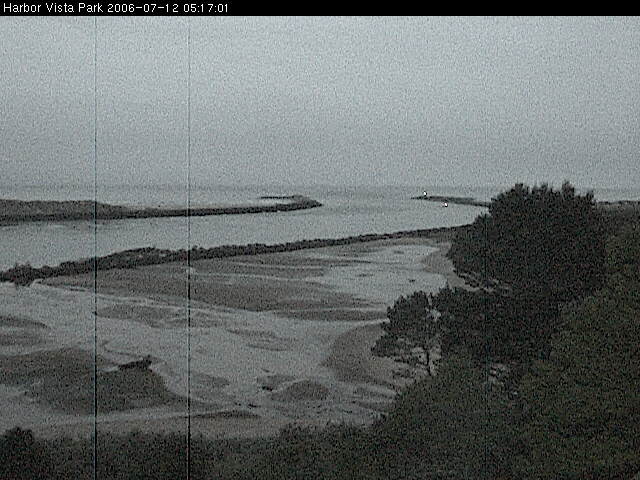
Suislaw rivermouth on the central coast...
Surf looks like it will be fun again today...
Tuesday, July 11, 2006

TONIGHT S WIND 10 TO 15 KT...RISING TO 15 TO 20 KT.
WIND WAVES 2 FT...BUILDING TO 4 FT.
W SWELL 3 FT AT 8 SECONDS.
Wasn't as big as the pic...but the water was smooth and glassy all day...the predicted wind was curiously absent...some fun little beach break peaks early in the day...moved north later for some continued glass...a little more lined up, better size and punchy...all in all...a fun day to be in the water.
Monday, July 10, 2006
Sunday, July 09, 2006

N WIND 10 TO 15 KT.
WIND WAVES 2 FT.
W SWELL 5 FT AT 9 SECONDS.
TONIGHT N WIND 10 TO 15 KT.
WIND WAVES 2 FT.
W SWELL 5 FT AT 9 SECONDS.
Summertime means the miles and miles of beach break in Oregon become surfable...
In winter most open breaks are generally too big and too consistent to get out...
It's only a matter of time before we start to grouse about the waves being too small...
Forgetting that only a few short months ago +20' swells were rolling through...
Get out there and enjoy...
Saturday, July 08, 2006

N WIND 5 TO 10 KT.
WIND WAVES 1 FOOT.
W SWELL 4 FT AT 10 SECONDS.
TONIGHT N WIND 10 TO 15 KT.
WIND WAVES 2 FT.
W SWELL 6 FT AT 9 SECONDS.
Couple days away...
After 20 years of living in Oregon I finally went and camped near Mt. St. Helens. Didn't get a chance to view the north side (next time), but explored the huge ash and mud flows on the south flank.
Surf looks to have bumped a bit from the holiday weekend. From all reports the surf was pretty miniscule...
Wednesday, July 05, 2006


NW WIND 5 TO 10 KT THIS MORNING.
RISING TO 10 TO 15 KT IN THE AFTERNOON.
WIND WAVES 1 FT.
W SWELL 3 FT AT 9 SECONDS.
TONIGHT NW WIND 10 TO 15 KT...EASING TO 5 TO 10 KT AFTER MIDNIGHT.
WIND WAVES 1 FT.
W SWELL 3 FT AT 9 SECONDS.
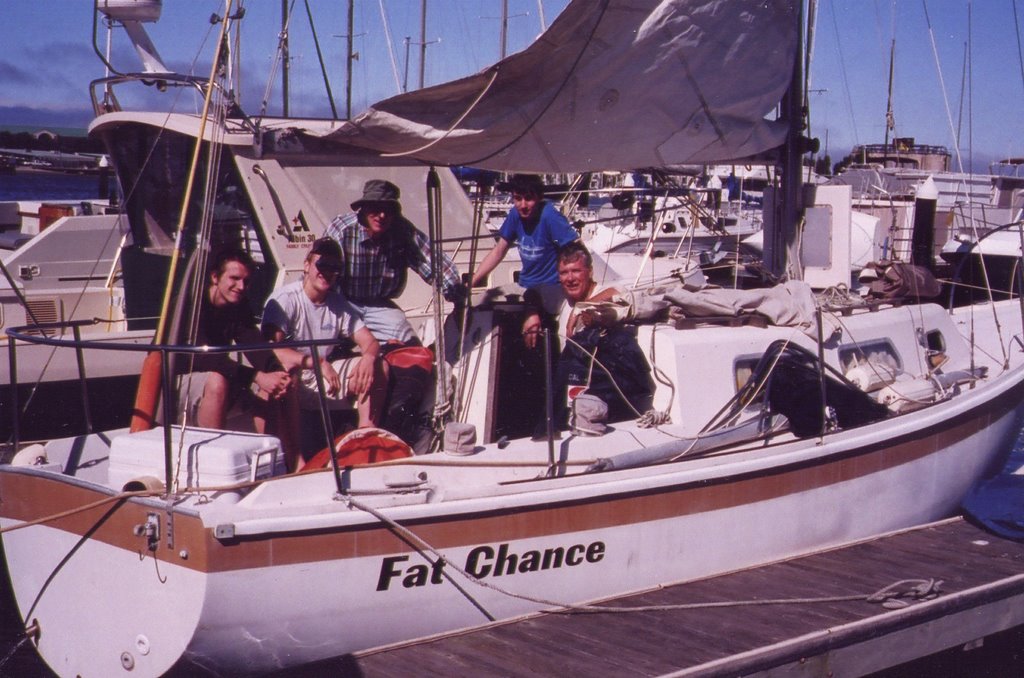
I received an e-mail from the father of one of the boys that was on the boat "Fat Chance", that sunk off Point Reyes in early June. He requested that I post an updated article that more accurately describes the tragic events from that day...
In the photo above, Andy Brinkley is the young man seated furthest back in the boat.
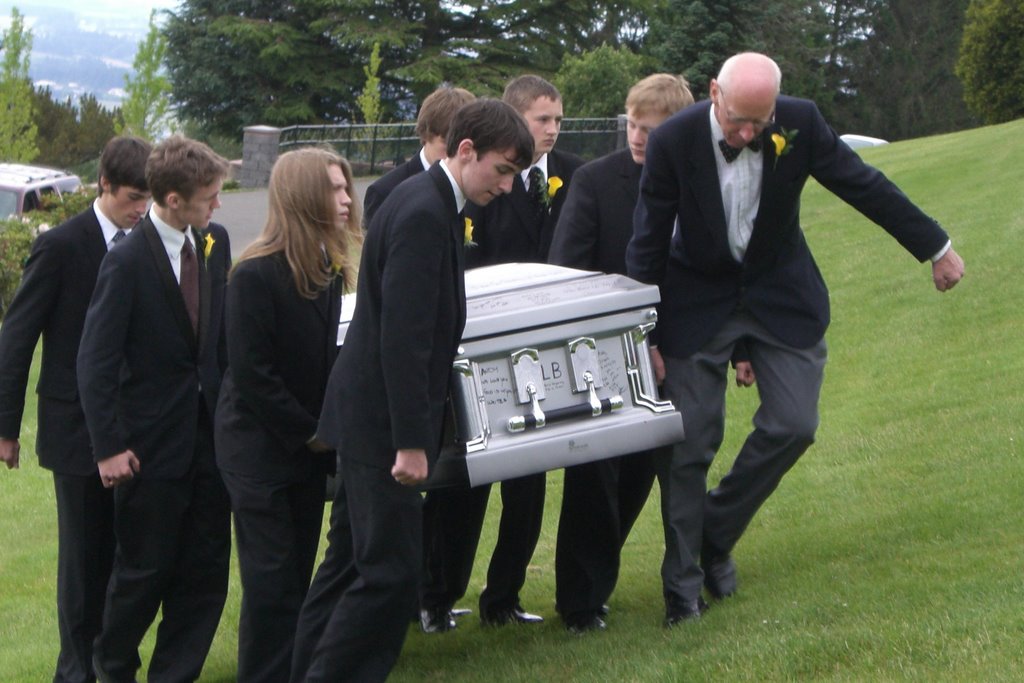
I attended Andy's Memorial...I had drawn some of my own conclusions about what had happened based upon the very limited information I had heard. I think I understand now why speakers at his service referred to Andy as a hero.
Life is a precious thing...full of surprise, adventure, love and laughter...it's also full of risk, choices, second guesses and regrets...
From The Oregonian, Thursday, June 8, 2006, Page One
‘Trip of a lifetime’ in the Pacific Ocean
turns tragic for recent graduate
Fresh from Lincoln High School, Andy Brinkley perishes
during a sailboat journey with his dad and two friends.
By David Austin
It started as Lincoln High School graduate Andrew Brinkley’s dream trip: three friends, two dads, a 29-foot sailboat called the Fat Chance and the wide-open Pacific Ocean.
Brinkley, 18, known as “Andy,” was fresh from last week’s walk across the graduation stage in Portland. He’d spent weeks talking about the trip. His father had just bought a boat in the San Francisco Bay Area, and the dads and boys would spend a week sailing it home to Portland.
But shortly after they set out, a rogue wave swept Brinkley into the frigid water and left him dead, his family and friends in mourning, and the Lincoln High community shaking at the second consecutive year that someone died shortly after graduation ceremonies.
“There’s always going to be a whole lot of ‘coulda, shoulda, woulda’ on this,” said Andy’s oldest sister, Jenny Brinkley, 32. “If you could just go back in time and repeat the events of the day, you’d take the opportunity without questioning it.”
Andy’s father is Ken Brinkley, who lives on a houseboat in North Portland and operates an auto shop in Vancouver. Jenny Brinkley said her father, an avid sailor, talked to his son, and they decided that a post-graduation sailing trip on the new boat would be a good idea.
Andy brought along two friends who also graduated from Lincoln: Marcus Tillett and Max Hamlin, both 18. Tillett’s dad, Paddy Tillett, a seasoned ocean sailor, joined them.
“They spent hours and hours going over all the charts and things, checking equipment and provisioning,” said Bryony Tillett, Paddy’s wife. “This was the trip of a lifetime for those boys.”
On Saturday, the dads and boys drove to San Francisco. Once there, they picked up the boat, bought more supplies and set sail Monday.
At the start, Jenny Brinkley said, the ocean was smooth with only a small-craft advisory that warned of slightly rough waters. Tuesday morning, they encountered 5-foot swells.
The wave strikes
Shortly before 7:40 a.m., a large wave swept Andy Brinkley and Paddy Tillett overboard. Paddy Tillett was connected to a safety line, but Andy, who was wearing a life jacket, had just gone on deck and hadn’t tethered yet.
Ken Brinkley was also on deck and connected to the safety line. He pulled Tillett aboard, then realized his son had been tossed into the sea.
Hamlin, the crew’s radioman, used the radio to broadcast a mayday call that was picked up by the U.S. Coast Guard. The swells made it hard to track Brinkley’s movement in the water, so his dad tried to turn the boat around. But the engine wouldn’t start.
They tried the radio again, but it was dead. They activated the emergency locator beacon that broadcast the boat’s location. Meantime, Andy Brinkley had drifted farther and farther from the boat.
The Coast Guard launched an 87-foot cutter from its Humboldt Bay station, two helicopters from San
Francisco, three 47-foot patrol boats from Bodega Bay and a C-130 rescue airplane from Sacramento. At 9:08 a.m., one of the helicopter crews spotted the sailboat about 35 miles west of Point Reyes, said Lt. John Fu of the Coast Guard’s San Francisco station.
Andy spotted
At 12:23 p.m., a helicopter crew spotted Andy Brinkley about three miles northwest of the Fat Chance and hoisted him out of the water. Crew members performed cardiopulmonary resuscitation as they flew to a Bay Area hospital. He was pronounced dead shortly afterward. An autopsy is planned today, his family said, but he probably died of hypothermia.
On Wednesday, Jenny Brinkley described her brother –the youngest of four children and the only boy –as “an old soul” who served as the glue for a family split by divorce.
“He was always looking to make peace,” Jenny Brinkley said by telephone from San Francisco. “He kept us all grounded and kept us all laughing. He was the nucleus of our family.”
She said her father, too distraught to talk, is a seasoned sailor who raised his children on a houseboat. Water, she said, was a way of life for the family.
“He’d been sailing for his entire life,” she said. “We were always around the water, and it was second nature to us. He says he’s going to move off his houseboat and never go sailing again. It’s all so sad.”
Mother’s memories
Pam Brinkley Brokaw, Andy’s mother, remembers the baby who arrived on Christmas Day and never caused any problems for his parents. That is, until he developed a fondness for playing practical jokes.
Brinkley Brokaw remembers when her son was 7 and – knowing his mother was afraid of spiders – began leaving a large, plastic one in crevices around the house.
“It used to frighten me so much, but we laughed about it,” she recalled. “Now, I’m at such a loss. How do you sum up 18 years of such an amazing person?”
At Lincoln, students walked quietly through the halls, consoling one another and talking with teachers. A makeshift memorial with Andy’s photograph sat on a table across from the main office. Amid flowers and other mementos was a large sign where students scribbled messages to Andy and his family.
Principal Peter Hamilton said staff and students were shocked. Andy’s death came a year after Matthew Neyhart, 18 and a Lincoln senior in 2005, died in a car accident on graduation day.
“It’s hard because (Brinkley) was such a nice kid,” Hamilton said. “And you think you’re done with graduation and everything, and this happens. It’s hard not to flash back to last year.”
Fellow students
Chelsie Fish and Koby Watt, both 17, graduated with Andy Brinkley and worked with him as teacher assistants in the main office. They remembered their friend as someone who did things his own way.
“We all had a little bit of a bond because we were always hanging out in the office together,” Fish said. “It’s definitely caught me by surprise because I would’ve never thought this kind of thing would happen to him.”
Watt shared the most outstanding office aide award with Andy Brinkley. He remembers the tall, skinny kid as having “unique qualities.”
“He was one of the funniest kids I know,” Watt said. “He always made me laugh.”
Andy Brinkley’s family wants to set up a scholarship fund in his name. Pam Brinkley Brokaw said her family will hold a memorial service next week. She urged parents not to be shy about being protective of their children.
“People used to give me such a bad time about being overly protective,” Brinkley Brokaw said, fighting back tears. “All those years of watching out for him and looking out for danger. You just never know when that moment’s going to come when they don’t come home.”
Tuesday, July 04, 2006

NW WIND 10 TO 15 KT...RISING TO 15 TO 20 KT IN THE AFTERNOON.
WIND WAVES 2 FT...BUILDING TO 4 FT IN THE AFTERNOON.
NW SWELL 3 FT AT 7 SECONDS.
TONIGHT NW WIND 15 KT.
WIND WAVES 3 FT.
NW SWELL 3 FT AT 8 SECONDS.
If only our 3 foot swells were as clean and lined up as this shot of Cojo in 1967...it comes together on occassion, but altogether too infrequently...
Monday, July 03, 2006

NW WIND 10 KT...BECOMING N 15 TO 20 KT IN THE AFTERNOON.
WIND WAVES 2 FT...BUILDING TO 4 FT IN THE AFTERNOON.
NW SWELL 3 FT AT 6 SECONDS.
TONIGHT N WIND 10 TO 15 KT.
WIND WAVES 2 FT.
NW SWELL 4 FT AT 7 SECONDS.
This cove was where the Lewis & Clark Expedition came to view the remains of a beached whale along with other Corps members, including Sacagawea, in 1806...
I used to surf here quite often in the early 90's. One particularly memororable stretch was during an El Nino year, where water temps soared, and I was able to trunk it on several occassions...
This break is somewhat off my regular routine these days. But when the sandbars are right, it can produce some fun waves.
Sunday, July 02, 2006

NW WIND 10 TO 15 KT.
BECOMING N 15 TO 20 KT IN THE AFTERNOON WITH LOCAL GUSTS TO 25 KT.
WIND WAVES 2 FT...BUILDING TO 4 FT IN THE AFTERNOON.
NW SWELL 5 FT AT 6 SECONDS.
TONIGHT N WIND 15 TO 20 KT.
WIND WAVES 4 FT.
NW SWELL 4 FT AT 6 SECONDS.
Classic Windansea shot...
As a kid growing up in PB, we occasionally would go to the Cove...I rememeber just getting rolled by the surge...it would suck you down the steep beach, then roll you back up it...10 yards off the beach, the water roiled with garibaldi and all kinds of colorful fish...
Saturday, July 01, 2006

NW WIND 10 TO 15 KT.
BECOMING N 15 TO 20 KT IN THE AFTERNOON...WITH A FEW GUSTS TO 25 KT.
WIND WAVES 2 FT...BUILDING TO 4 FT IN THE AFTERNOON.
NW SWELL 4 FT AT 7 SECONDS.
TONIGHT N WIND 15 TO 20 KT.
BECOMING NW 10 TO 15 KT AFTER MIDNIGHT.
WIND WAVES 4 FT...SUBSIDING TO 2 FT AFTER MIDNIGHT.
NW SWELL 5 FT AT 7 SECONDS.
Summer is here...
Sunny days, tiny surf...
Foggy days, gutless waves...
Lotsa wind, can't drop in...
Stickered cars littered...
With soft tops...
Jam the lots...
Flotsam & Jetsam...
Of the kook variety...
Bobbing about...
Mindlessly, cluelessly...
In the mini impact zone...
Human slalom course...
Still...
That rare day...
Can occur...
When the surf bumps...
Overhead & solid...
With none of that...
Pesky winter power...
Allowing fun...
Liquid curtains...
To be drawn...
Like lightweight blankets...
Over your head...
At bedtime...